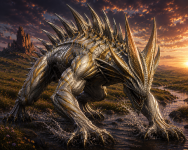

𝔹𝕒𝕤𝕚𝕔 𝕀𝕟𝕗𝕠𝕣𝕞𝕒𝕥𝕚𝕠𝕟
────────────────── ✦ ──────────────────
ℕ𝕒𝕞𝕖: Kusha
𝔾𝕖𝕟𝕕𝕖𝕣(𝕤): Homogamous
ℍ𝕖𝕚𝕘𝕙𝕥: 8 Feet
𝕎𝕖𝕚𝕘𝕙𝕥: Unknown
ℙ𝕝𝕒𝕔𝕖 𝕆𝕗 𝕆𝕣𝕚𝕘𝕚𝕟: Argent Meadows
ℂ𝕦𝕣𝕣𝕖𝕟𝕥 𝕃𝕠𝕔𝕒𝕥𝕚𝕠𝕟(𝕤): Primarily open meadows, river valleys, wetlands, grasslands, and lightly forested wilderness. Individual Kusha have occasionally wandered into rural settlements after being provoked or attracted by large concentrations of movement.
ℂ𝕝𝕒𝕤𝕤𝕚𝕗𝕚𝕔𝕒𝕥𝕚𝕠𝕟: Kaijn
𝕃𝕚𝕗𝕖 𝕊𝕥𝕒𝕥𝕦𝕤: Alive
𝕎𝕠𝕣𝕝𝕕 𝕊𝕥𝕒𝕥𝕦𝕤: Roaming
✦ ─────── K-101 ─────── ✦
𝕆𝕥𝕙𝕖𝕣 𝕀𝕟𝕗𝕠𝕣𝕞𝕒𝕥𝕚𝕠𝕟
────────────────── ✦ ──────────────────
ℂ𝕠𝕣𝕖 𝕊𝕥𝕒𝕥𝕦𝕤: Intact
ℂ𝕠𝕣𝕖 𝕋𝕪𝕡𝕖: Aurum Reconstruction Core
Kusha possesses an unusually dense, metallic-looking Core buried deep behind the sternum. It resembles an irregular silver crystal split by brilliant golden veins that continuously rearrange themselves across its surface. Unlike most Kryptid Cores, it does not remain physically static; fragments periodically separate, rotate around the central mass, and fuse back together as though the Core is constantly rebuilding itself. Noktis researchers believe this is the biological engine behind Kusha's ability to disassemble and reconstruct matter. Even after death, direct physical contact with the Core is considered extremely dangerous because residual energy may attempt to restructure whatever touches it.
ℙ𝕖𝕣𝕤𝕠𝕟𝕒𝕝𝕚𝕥𝕪 𝕋𝕪𝕡𝕖: Hyper-Aggressive & Territorial
The Kusha possesses little tolerance for anything entering their perceived territory and frequently attacks without displaying traditional warning behaviors. It does not hunt exclusively for food; specimens have been documented pursuing targets long after feeding requirements should have been satisfied. Despite this aggression, Kusha is not mindless. It demonstrates strong predatory intelligence, recognizes threats, remembers attacks, and deliberately manipulates terrain to trap opponents.
ℂ𝕒𝕥𝕖𝕘𝕠𝕣𝕪: V
𝔸𝕝𝕡𝕙𝕒 𝕂𝕦𝕤𝕙𝕒: An Alpha is the largest, oldest, and most dangerous member of a Kusha pack. Unlike ordinary Kusha, the Alpha possesses a silver body marked by brilliant golden stripes, enormous blade-like spines extending down the center of its back, and a distinctive crown-shaped growth emerging from its skull. These structures are connected directly to its Core and function as biological conductors rather than decoration. An Alpha can send reconstruction energy through the ground and allow other Kusha touching the same terrain to react to its commands. The Alpha rarely rushes into combat first. Instead, it directs the pack while studying how prey responds, allowing lesser Kusha to attack from multiple directions. Once it identifies the strongest opponent or recognizes an opening, the Alpha personally enters the fight. Killing the Alpha can severely disrupt a pack, but it also causes surviving Kusha to enter an extremely aggressive frenzy.
ℕ𝕠𝕜𝕥𝕚𝕤 𝔸𝕤𝕤𝕖𝕤𝕤𝕞𝕖𝕟𝕥: Kusha are never to be treated as individual targets. Where one specimen has been observed, operatives must assume additional pack members are concealed nearby. Their ability to coordinate Matter Reconstruction allows several specimens to manipulate the same area simultaneously, turning terrain into an extension of the pack itself. Locating the Alpha is considered the first priority during any Kusha operation. Alpha specimens coordinate pack movements and dramatically increase the effectiveness of surrounding Kusha. However, eliminating the Alpha does not immediately neutralize the threat. Surviving pack members commonly enter a frenzy following Alpha termination. Category V response authorization is mandatory for confirmed packs, and direct engagement without heavy Aegis support is prohibited

ℂ𝕠𝕞𝕓𝕒𝕥 𝕀𝕟𝕗𝕠𝕣𝕞𝕒𝕥𝕚𝕠𝕟
────────────────── ✦ ──────────────────
𝕊𝕥𝕣𝕖𝕟𝕘𝕥𝕙: 9/10 | Alpha: 10/10
Kusha possess tremendous physical strength even before using Matter Reconstruction. Their oversized shoulders, elongated arms, powerful hind legs, and low center of gravity allow them to fight comfortably on all fours, using their entire body as a weapon. A normal adult can overturn armored vehicles, tear through reinforced doors, uproot smaller trees, and launch humans several meters with a single swipe. Their claws are especially dangerous because Kusha instinctively combine physical strikes with their reconstruction ability; surviving the initial impact does not necessarily mean surviving what happens after contact. An Alpha Kusha possesses physical strength beyond ordinary members of the species. Its enlarged skeletal structure and reconstructed muscle fibers allow it to overpower other Kusha and smash through defenses designed to withstand lesser Kryptids. The Alpha's preferred attacks involve charging on all fours, impaling targets with its crown, crushing opponents beneath its forelimbs, or using its massive tail as a sweeping weapon. Its dorsal spines also provide additional mass and stability, allowing the Alpha to remain planted even against extremely powerful impacts. The pack makes this strength significantly more dangerous. Kusha rarely waste time fighting an opponent one-on-one. One may tackle or restrain prey while another attacks from the side, and stronger individuals intentionally drive enemies toward waiting pack members. Against particularly powerful Superhumans, several Kusha may attack simultaneously rather than taking turns.
𝕊𝕡𝕖𝕖𝕕: 8/10 | Alpha: 9/10
Their size gives the misleading impression that Kusha are slow. Their bodies are actually designed for explosive quadrupedal movement, with disproportionately powerful legs and long forelimbs that allow them to rapidly pull themselves forward. A Kusha can transition almost instantly between crouching, sprinting, climbing, pouncing, and crawling. They are particularly dangerous across uneven terrain because obstacles that would slow a human can simply be climbed over, jumped across, or reconstructed. Their acceleration is more impressive than their sustained speed. Kusha specialize in sudden bursts intended to close distance before an opponent can react. During hunts, pack members deliberately alternate pursuit duties. One Kusha pressures the prey until it begins slowing down, then another takes over from a different direction. This allows the pack to exhaust targets without requiring every member to continuously expend energy. The Alpha is even faster despite being considerably larger. Through self-reconstruction, its joints, tendons, and muscles have become optimized for explosive movement. When necessary, an Alpha can temporarily reconstruct its legs to increase their density and power, producing extremely violent charges. Noktis reports warn Hunters not to interpret the Alpha's tendency to remain stationary during the beginning of combat as sluggishness. it is usually watching.
𝔻𝕦𝕣𝕒𝕓𝕚𝕝𝕚𝕥𝕪: 9/10 | Alpha: 10/10
Kusha skin consists of dense silver biological plating layered over exceptionally thick muscle and reinforced bone. Their golden stripes are actually exposed channels carrying Core energy throughout their bodies. Blades, conventional firearms, blunt trauma, and environmental hazards that would severely injure most creatures may only produce superficial wounds against a mature Kusha. Their bones are also unusually flexible, making fractures considerably more difficult to inflict. Damage that does penetrate their defenses activates the Aurum Carapace. Core energy automatically moves toward the damaged region, hardening surrounding tissue and beginning reconstruction. This means repeated attacks against the exact same location can actually become less effective as the creature reinforces that section of its body. Hunters are therefore trained to vary their attack patterns rather than repeatedly targeting one limb. The Alpha's armor is substantially denser. Its crown, spinal blades, shoulders, forearms, and chest possess multiple reconstructed layers that function like natural heavy armor. The Alpha can also deliberately move biological material toward threatened areas, temporarily sacrificing protection elsewhere to make one location exceptionally difficult to penetrate.
𝕀𝕟𝕥𝕖𝕝𝕝𝕚𝕘𝕖𝕟𝕔𝕖: 7/10 | Alpha: 9/10
Kusha are not human-level thinkers, but their predatory intelligence is exceptional. They understand ambushes, flanking, retreat, baiting, environmental advantages, and threat prioritization. Individual Kusha quickly recognize which opponents possess ranged weapons, healing abilities, mobility powers, or particularly dangerous Aegis Arms. Rather than blindly attacking whoever stands closest, they frequently target whichever opponent contributes the most to keeping the group alive. Their pack intelligence makes them particularly deceptive. A wounded Kusha may deliberately retreat to encourage Hunters to pursue it into an ambush. Another may remain visible while several pack members move through concealed trenches created through Matter Reconstruction. They have even demonstrated an understanding of escape routes, destroying bridges, raising walls, or altering riverbanks before beginning an attack. Alpha intelligence is significantly greater. Experienced Alphas can observe a squad for extended periods before entering combat and seemingly recognize repeated tactical patterns. They coordinate their pack through Core resonance, assigning different members to pursuit, defense, flanking, or environmental manipulation. An Alpha may even intentionally sacrifice a lesser Kusha if doing so creates an opportunity to eliminate a significantly more dangerous enemy.
ℝ𝕖𝕘𝕖𝕟𝕖𝕣𝕒𝕥𝕚𝕠𝕟: 10/10 | Alpha: 10+/10
Regeneration is among the most dangerous aspects of Kusha biology because they do not merely heal wounds, they reconstruct themselves. Damaged tissue is broken apart and reorganized into healthy tissue using instructions generated by the Core. Broken bones can reconnect, damaged organs can be restored, torn muscles can reform, and severed limbs can eventually be replaced. Nearby matter can accelerate this process. By touching soil, stone, vegetation, or biological material, Kusha can break it down and use compatible components as reconstruction material. The resulting tissue is eventually converted into proper Kryptid biology by Core energy. Because of this, severely damaging a Kusha without finishing it may only temporarily remove it from battle. Pack behavior makes regeneration even more troublesome. Injured members frequently retreat behind healthier Kusha while recovering. The pack may even restructure terrain around the wounded individual, effectively creating temporary shelters. The Alpha possesses the most refined reconstruction system. Catastrophic injuries that would permanently cripple lesser Kryptids can potentially be repaired if its Core remains functional. However, reconstruction requires enormous amounts of Core energy, making continuous overwhelming damage one of the few reliable methods of exhausting it.
𝔸𝕕𝕒𝕡𝕥𝕒𝕓𝕚𝕝𝕚𝕥𝕪: 9/10 | Alpha: 10/10
Kusha adaptation differs from traditional evolutionary adaptation. Instead of slowly developing resistance over generations, an individual can physically redesign portions of itself during battle. If additional protection is required, it can increase armor thickness. If an enemy repeatedly remains beyond clawing range, its limbs or claws can temporarily elongate. If mobility becomes more important than protection, excess armor can be reduced and redistributed into the legs. This ability does have limits. Kusha cannot spontaneously develop completely unrelated supernatural powers, nor can they perfectly counter something they do not understand. Their adaptations must be produced using their existing biological structure and Matter Reconstruction. The Alpha represents the extreme conclusion of this ability. Its enormous spinal blades, crown-like head structure, reinforced limbs, and increased size are essentially accumulated improvements produced throughout its lifetime. Every Alpha is therefore slightly different depending on what threats it survived before assuming leadership.
𝕎𝕖𝕒𝕜𝕟𝕖𝕤𝕤: Pack Separation / Core Exhaustion / Golden Fracture
Kusha are at their strongest when fighting together on connected terrain. Separating them dramatically reduces their effectiveness. Aerial combat, isolated platforms, destroyed bridges, deep gaps, and other methods of preventing continuous contact with the environment can interfere with Pack Reconstruction Chains. Their Matter Reconstruction also consumes Core energy proportional to the complexity and scale of the transformation. Small spikes or repairing superficial wounds cost relatively little. Reconstructing massive areas while simultaneously regenerating severe injuries requires enormous amounts of energy. Forcing a Kusha into repeated large-scale reconstruction can gradually exhaust it. Extreme exhaustion eventually triggers Golden Fracture. The golden stripes across the body begin glowing intensely and intermittently flickering as excess energy destabilizes the reconstruction network. Regeneration slows, armor redistribution becomes unreliable, and the normally protected Core region becomes substantially more vulnerable. The greatest complication is that Hunters must decide whether to target the Alpha first. Removing it destroys the pack's coordination and prevents Alpha-amplified reconstruction but its death immediately triggers an intense Pack Frenzy. Every surviving Kusha becomes violently aggressive and attacks the Alpha's killer with little regard for injury or self-preservation. For this reason, Noktis summarizes Kusha combat doctrine with a simple warning
✦ ─────── K-101 ─────── ✦
𝔸𝕓𝕚𝕝𝕚𝕥𝕪 𝕀𝕟𝕗𝕠𝕣𝕞𝕒𝕥𝕚𝕠𝕟
────────────────── ✦ ──────────────────
ℙ𝕣𝕚𝕞𝕒𝕣𝕪 𝔸𝕓𝕚𝕝𝕚𝕥𝕪: Matter Reconstruction
𝔸𝕓𝕚𝕝𝕚𝕥𝕪 𝔻𝕖𝕤𝕔𝕣𝕚𝕡𝕥𝕚𝕠𝕟: Kusha can disassemble and reconstruct physical matter through contact. Earth can become spikes, stone can become armor, rivers can be redirected, structures can collapse, and living tissue can be broken down or reconstructed. Because several pack members can manipulate different portions of the environment simultaneously, fighting a pack can make the entire environment appear to be alive.
ℙ𝕒𝕤𝕤𝕚𝕧𝕖 𝔸𝕓𝕚𝕝𝕚𝕥𝕪 #𝟙: Pack Resonance
Every Kusha releases a subtle Core frequency detectable by others of its species. This creates an almost instinctive communication network between pack members, allowing them to coordinate without audible commands. An Alpha's stronger Core dominates this network, effectively functioning as the pack's central command point. The Alpha can communicate danger, prey location, attack direction, retreat commands, and environmental changes through these pulses. This makes a Kusha pack disturbingly synchronized despite possessing no spoken language.
ℙ𝕣𝕚𝕞𝕒𝕣𝕪 𝔸𝕓𝕚𝕝𝕚𝕥𝕪 #𝟚: Cataclysmic Terrain
Kusha can transmit reconstruction energy through surfaces beneath them, violently reshaping the surrounding landscape. Packs exploit this ability cooperatively: one Kusha may collapse the ground beneath prey while another creates barriers to prevent escape and a third launches spikes from an entirely different direction. When multiple Kusha connect their abilities through the same terrain, their effective range and complexity increase dramatically. An Alpha takes this synchronization even further. Its crown and dorsal spines function as enormous Core-energy conductors, allowing it to coordinate several reconstruction effects simultaneously. Within established Alpha territory, even experienced Hunters can struggle to determine which Kusha actually initiated an attack.
ℙ𝕣𝕚𝕞𝕒𝕣𝕪 𝔸𝕓𝕚𝕝𝕚𝕥𝕪 #𝟛: Chimera Reconstruction
Kusha can restructure their own bodies for combat, enlarging claws, reinforcing limbs, moving armor toward damaged areas, regenerating lost tissue, or developing temporary biological weapons. Pack members can even transfer available material toward severely injured members, accelerating their recovery. Alpha specimens have perfected this process. Their crown and enormous spinal blades are the result of years of repeated self-reconstruction, essentially turning the Alpha into a naturally evolving living weapon.

✦ ─────── K-101 ─────── ✦
ℍ𝕚𝕤𝕥𝕠𝕣𝕪
────────────────── ✦ ──────────────────
The first confirmed Kusha encounter initially led Noktis to believe the species was solitary. Hunters discovered enormous stretches of meadow that had seemingly been torn apart and rebuilt, with rivers redirected, trees embedded into stone, and enormous formations rising from otherwise flat grassland. A single Kusha was eventually observed near the center of the territory. When Noktis attempted to approach it, however, six additional creatures erupted from reconstructed cavities beneath the meadow. The first specimen had never been alone, it had deliberately remained visible while its pack surrounded the Hunters. Subsequent observation revealed that Kusha are highly organized pack predators. Most packs contain between four and twelve members and claim large territories surrounding rivers or other reliable sources of water. They do not simply chase prey. Several Kusha will stalk a target from different directions while others manipulate the terrain, gradually directing prey toward a chosen kill zone. Particularly experienced packs have even been observed deliberately allowing prey to escape in one direction because another Kusha was already waiting there.
Every established pack possesses a single Alpha, recognizable by its silver-and-gold coloration, enormous dorsal spines, larger body, and crown-like cranial structure. Noktis originally assumed these traits represented a separate Kusha subspecies. Continued study instead suggested that any sufficiently powerful Kusha could potentially become an Alpha. Through repeated battles, feeding, reconstruction, and exposure to Core energy, one specimen eventually undergoes an extreme metamorphosis that permanently restructures its body. Once established, the Alpha becomes the center of the pack. Lesser Kusha hunt around it, respond to its Core signals, defend it against major threats, and even bring captured prey into its territory. The Alpha in return provides organization and dramatically improves their collective Matter Reconstruction. Packs led by experienced Alphas have transformed entire valleys into elaborate hunting grounds filled with artificial cliffs, concealed tunnels, redirected waterways, and structures specifically designed to funnel prey toward ambushes.
Their cooperative behavior is the primary reason Noktis maintains the species' Category V classification. A single Kusha is already capable of overwhelming inexperienced Hunters, but an established pack behaves more like a coordinated supernatural military unit than a group of animals. Each member performs a role, covers openings created by another, and uses the environment to compensate for injured packmates. An Alpha effectively turns those individual predators into pieces of a single larger organism. Noktis therefore teaches one rule above all others regarding Kusha territory: never assume the creature you can see is the creature hunting you. The visible Kusha may simply be bait, while the rest of its pack waits beneath reconstructed terrain, inside nearby vegetation, or along the escape route. And if the silver-and-gold Alpha finally emerges from hiding, Noktis considers the hunt to have entered its most dangerous stage.
Normal - Alpha