𝔹𝕒𝕤𝕚𝕔 𝕀𝕟𝕗𝕠𝕣𝕞𝕒𝕥𝕚𝕠𝕟
────────────────── ✦ ──────────────────
ℕ𝕒𝕞𝕖: Nid Ceirw / Not Deer
𝔾𝕖𝕟𝕕𝕖𝕣(𝕤): Male & Female
ℍ𝕖𝕚𝕘𝕙𝕥: 6'4"–7'2" at the shoulder | 9'–11' standing upright
𝕎𝕖𝕚𝕘𝕙𝕥: 620 – 940 lbs
ℙ𝕝𝕒𝕔𝕖 𝕆𝕗 𝕆𝕣𝕚𝕘𝕚𝕟: Appalachian Mountain Region, United States
ℂ𝕦𝕣𝕣𝕖𝕟𝕥 𝕃𝕠𝕔𝕒𝕥𝕚𝕠𝕟(𝕤): Dense forests, mountainous regions, abandoned rural communities, nature preserves, woodland roads, and isolated areas throughout Parros Island
ℂ𝕝𝕒𝕤𝕤𝕚𝕗𝕚𝕔𝕒𝕥𝕚𝕠𝕟: Kaiju
𝕃𝕚𝕗𝕖 𝕊𝕥𝕒𝕥𝕦𝕤: Alive
𝕎𝕠𝕣𝕝𝕕 𝕊𝕥𝕒𝕥𝕦𝕤: Roaming
✦ ─────── K-101 ─────── ✦
𝕆𝕥𝕙𝕖𝕣 𝕀𝕟𝕗𝕠𝕣𝕞𝕒𝕥𝕚𝕠𝕟
────────────────── ✦ ──────────────────
ℂ𝕠𝕣𝕖 𝕊𝕥𝕒𝕥𝕦𝕤: Intact
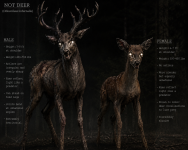
ℂ𝕠𝕣𝕖 𝕋𝕪𝕡𝕖: The Nid Ceirw possesses an unusual Mimetic Core located directly behind its sternum. Rather than being spherical, the Core resembles a malformed black heart wrapped in branching structures resembling antlers. Its surface is covered in thin silver veins that repeatedly change position, while the interior produces a dim amber glow resembling reflected animal eyes in darkness. The Core constantly analyzes surrounding organisms through vibrations, scent, sound, and visual information. It then sends instructions throughout the Nid Ceirw's body, allowing bones, muscles, skin, fur, and organs to reorganize themselves. This is the biological mechanism responsible for its unnatural ability to imitate ordinary wildlife. Removed Nid Ceirw Cores remain active for several hours and have occasionally attempted to grow primitive bone structures around themselves. Noktis personnel are prohibited from handling recovered specimens without sealed containment equipment.
ℙ𝕖𝕣𝕤𝕠𝕟𝕒𝕝𝕚𝕥𝕪 𝕋𝕪𝕡𝕖: Patient | Observant | Territorial | Predatory | Deceptive | Disturbingly curious.
A Nid Ceirw rarely behaves like a mindless animal. It prefers watching potential prey before attacking and may follow someone for hours without revealing itself. Older specimens have demonstrated an understanding of roads, doors, firearms, vehicles, hunting equipment, and basic human routines. They seem particularly fascinated by people who notice their disguise. Once a person realizes that they are looking at something other than a deer, the Nid will often stop pretending to behave naturally and simply stare back.
ℂ𝕒𝕥𝕖𝕘𝕠𝕣𝕪: III
ℕ𝕠𝕜𝕥𝕚𝕤 𝔸𝕤𝕤𝕖𝕤𝕤𝕞𝕖𝕟𝕥: "Nid Ceirw represent one of the greatest identification hazards among terrestrial Kaiju. Never assume an apparently ordinary animal within a contaminated region is harmless. Subjects have remained motionless for several hours while observing Noktis patrols and have demonstrated enough intelligence to avoid traps after witnessing another Nid Ceirw captured by the same method. Operatives encountering suspected specimens are instructed to maintain distance and observe the eyes, gait, and limb articulation. Do not approach for confirmation. If the animal maintains prolonged eye contact, fails to display an appropriate prey response, or begins producing repetitive clicking sounds, assume Nid Ceirw identification immediately. A minimum four-person Hunter unit is recommended for extermination. Severing limbs is ineffective unless the Core is simultaneously damaged. Under no circumstances should an operative pursue a wounded specimen alone into dense vegetation."
ℂ𝕠𝕞𝕓𝕒𝕥 𝕀𝕟𝕗𝕠𝕣𝕞𝕒𝕥𝕚𝕠𝕟
────────────────── ✦ ──────────────────
𝕊𝕥𝕣𝕖𝕟𝕘𝕥𝕙: 6/10
A Nid Ceirw is considerably stronger than any natural deer and possesses enough physical power to overpower an ordinary human with ease. Its kicks can fracture bones, its antlers can pierce lightly armored targets, and a charging adult can knock a Hunter several meters backward. However, it lacks the overwhelming strength associated with higher-category Kryptids. Reinforced structures, heavy Aegis armor, and physically powerful Superhumans can withstand or overpower it.
𝕊𝕡𝕖𝕖𝕕: 8/10
Speed is the Nid Ceirw greatest conventional combat advantage. Its abnormal leg structure allows it to accelerate rapidly, maintain impressive speeds through dense forests, and suddenly change direction using joints that ordinary animals do not possess. It is particularly dangerous at short distances, where it can transition from complete stillness into a charge almost instantly. Despite this, trained Hunters with enhanced mobility or specialized Aegis equipment can keep pace with it.
𝔻𝕦𝕣𝕒𝕓𝕚𝕝𝕚𝕥𝕪: 5/10
Nid Ceirw are tougher than ordinary wildlife but are not heavily armored Kryptids. Conventional firearms can injure them, while Aegis Arms can cause significant damage. Their flexible skeletal structure makes fractures less debilitating than expected, but sufficient physical trauma can incapacitate them. Direct attacks against the chest are particularly effective because the Mimetic Core is located behind the sternum.
𝕀𝕟𝕥𝕖𝕝𝕝𝕚𝕘𝕖𝕟𝕔𝕖: 7/10
Nid Ceirw display predatory intelligence rather than human-level reasoning. They understand ambushes, recognize obvious threats, remember dangerous locations, and can learn from failed attacks. Mature specimens may recognize weapons or common hunting tactics after repeated exposure. Their intelligence is most effective when stalking prey, but unfamiliar technology and complex strategies can confuse them.
ℝ𝕖𝕘𝕖𝕟𝕖𝕣𝕒𝕥𝕚𝕠𝕟: 5/10
The Nid Ceirw possesses moderate regenerative capabilities. Cuts and smaller wounds can close over several minutes, while damaged muscles and minor fractures may recover within several hours. Severe wounds remain dangerous, and lost limbs cannot simply regenerate during combat. Damage to the Mimetic Core dramatically reduces healing and can cause the creature's altered anatomy to destabilize.
𝔸𝕕𝕒𝕡𝕥𝕒𝕓𝕚𝕝𝕚𝕥𝕪: 8/10
Biological adaptation remains the species' defining characteristic, but it is not instantaneous evolution. A Nid Ceirw requires repeated exposure and observation before developing significant changes. Adaptations usually occur over days, weeks, or even months. It therefore cannot simply become resistant to an Aegis weapon during a single battle.
𝕎𝕖𝕒𝕜𝕟𝕖𝕤𝕤:
✦ ─────── K-101 ─────── ✦
𝔸𝕓𝕚𝕝𝕚𝕥𝕪 𝕀𝕟𝕗𝕠𝕣𝕞𝕒𝕥𝕚𝕠𝕟
────────────────── ✦ ──────────────────
ℙ𝕣𝕚𝕞𝕒𝕣𝕪 𝔸𝕓𝕚𝕝𝕚𝕥𝕪: Biomimicry
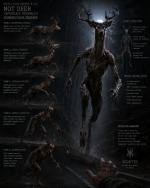
𝔸𝕓𝕚𝕝𝕚𝕥𝕪 𝔻𝕖𝕤𝕔𝕣𝕚𝕡𝕥𝕚𝕠𝕟: Biomimicry allows the Falsehart to restructure its own anatomy after observing living organisms. Unlike conventional shapeshifting, it cannot instantly become a perfect copy of another creature. Instead, its Core studies biological characteristics and reconstructs useful features across the Nid Ceirw's existing body. A specimen living among whitetail deer will therefore gradually resemble a deer. One hunting around elk may become considerably larger and develop massive antlers. Specimens repeatedly encountering wolves have developed canine teeth, enhanced scent receptors, padded feet, and stronger jaws. This produces the unsettling inconsistencies associated with Nid Ceirw sightings. What appears to be a deer may possess the eyes of a predator, an elongated canine jaw, primate-like shoulder articulation, several additional leg joints, or musculature completely inappropriate for a herbivore. When threatened, the disguise can be abandoned entirely. Bones unlock from hidden joints. The rib cage expands. The spine lengthens. Forelegs rotate into grasping limbs. The jaw separates farther than its false deer anatomy should permit, exposing several rows of narrow carnivorous teeth. The animal that witnesses initially mistook for a deer is therefore merely the shape the Nid Ceirw has chosen to wear.
ℙ𝕒𝕤𝕤𝕚𝕧𝕖 𝔸𝕓𝕚𝕝𝕚𝕥𝕪 #𝟙: Wrongness Response
The not deer unconsciously produces extremely low-frequency vibrations through its chest cavity. Humans and animals usually cannot consciously hear these frequencies, but the body detects them. Exposure creates escalating uneasiness, paranoia, elevated heart rate, goosebumps, and the overwhelming sensation of being watched. This effect explains why many people realize something is wrong before they actually identify what is visually abnormal about the creature. Animals react even more strongly. Dogs may refuse to approach contaminated woodland, horses become uncontrollable, and ordinary deer frequently abandon areas occupied by mature Nid's. Noktis operatives therefore treat unexplained environmental silence and sudden instinctive anxiety as potential early-warning signs.
ℙ𝕣𝕚𝕞𝕒𝕣𝕪 𝔸𝕓𝕚𝕝𝕚𝕥𝕪 #𝟚: Borrowed Voice
A Nid Ceirw can reproduce sounds after hearing them repeatedly. Young specimens primarily imitate animals: deer calls, birds, coyotes, injured wildlife, or barking dogs. Older ones become considerably more dangerous, human speech can be replicated after sufficient exposure, although the creature does not initially understand language. It instead learns that particular sounds cause particular reactions. It might hear someone repeatedly calling another person's name and later reproduce that name from the forest. It may imitate crying, laughter, someone calling for help, or the voice of a missing companion. These creatures may eventually associate words with meaning and can construct short sentences. Noktis considers the not deet capable of conversational mimicry which is a immediate escalation threat.
ℙ𝕣𝕚𝕞𝕒𝕣𝕪 𝔸𝕓𝕚𝕝𝕚𝕥𝕪 #𝟛: Unnatural Articulation
Every major bone in this kryptid contains several dormant joints. These joints normally remain locked together, creating the appearance of conventional deer anatomy, though they can separate. Its legs can suddenly bend sideways or backward. Shoulders rotate almost completely around. Its neck can twist far beyond mammalian limitations, and its spine can temporarily elongate by separating individual vertebral segments. This allows the creature to perform seemingly impossible movements without injuring itself. It can flatten its body beneath obstacles, climb steep surfaces using rearranged limbs, suddenly stand upright, leap sideways without turning, or continue attacking despite its limbs being bent into positions that would make it appear to be cripple. The most infamous manifestation occurs during pursuit, A not deer running on four legs can gradually straighten its spine without losing momentum, transitioning into a towering bipedal sprint while its forelimbs unfold into long grasping arms. Noktis field reports refer to this behavior as "Standing Chase."
✦ ─────── K-101 ─────── ✦
ℍ𝕚𝕤𝕥𝕠𝕣𝕪
────────────────── ✦ ──────────────────
The Nid Ceirw was never a naturally occurring Kryptid. Its existence can be traced back to an early appearance of The Reaper, long before Noktis fully understood how dangerously transformative its biology could be. During The Reaper's passage through a heavily wooded region, numerous animals were discovered dead, dying, or severely mutated throughout the surrounding wilderness. Investigators would eventually learn that The Reaper's blood itself possessed the ability to corrupt and restructure living organisms when introduced directly into their bloodstream. The first Nid Ceirw was created entirely by accident when a mature deer, already dying from severe injuries and blood loss, stumbled through an area contaminated by The Reaper's blood. One of the deer's open wounds came into contact with the blood, allowing a small amount to enter its bloodstream while the animal was only minutes away from death.
Instead of dying, the deer began violently convulsing as The Reaper's blood circulated throughout its failing body. Its heart stopped and restarted repeatedly, broken bones shifted beneath its skin, damaged muscles reconnected, and organs that had already begun shutting down were forcibly reconstructed. The Reaper's blood was not healing the deer in a conventional sense. Instead, it was violently altering the animal into something capable of surviving injuries that should have killed it. The deer's body desperately attempted to stabilize itself around the foreign material, eventually causing its nervous system, immune system, and remaining healthy cells to become intertwined with traces of The Reaper's biology. During this process, a completely new organ developed behind its sternum. This organ became what Noktis would later identify as the Mimetic Core, acting as an intermediary between the deer's original biology and the mutative properties inherited from The Reaper.
By sunrise, the deer was alive, but it was no longer truly a deer. From a distance, its appearance remained convincing enough to mistake it for an ordinary animal, but closer examination would have revealed numerous abnormalities. Its legs contained additional joints, its eyes gradually shifted farther forward, its teeth developed characteristics belonging to both herbivores and carnivores, and its spine became capable of extending beyond its natural length. Muscles around its shoulders developed articulation completely incompatible with normal cervid anatomy, while its internal organs rearranged themselves into structures capable of supporting its new body. Most disturbing was the creature's apparent ability to intentionally control these abnormalities. When other animals approached, portions of its anatomy could return to a more convincing deer-like configuration, effectively allowing the creature to hide what it had become.
The newly created creature disappeared into the wilderness before its transformation could be documented. Over the following years, strange reports began appearing throughout nearby communities. Hunters described deer that watched them rather than fleeing, while drivers encountered animals standing motionless beside roads for unnaturally long periods. Other witnesses reported deer with forward-facing eyes, strangely proportioned bodies, limbs bending in impossible directions, or animals that appeared to stand upright before disappearing into the forest. Many described an overwhelming sensation that whatever they were observing understood that it had been noticed. These reports were initially dismissed as injured wildlife, disease, poor visibility, or frightened witnesses exaggerating otherwise ordinary encounters.
The original Nid Ceirw survived long enough for its mutation to become something much more dangerous than an isolated incident. Noktis eventually discovered that exposure to The Reaper's blood had permanently rewritten portions of the deer's reproductive biology. When the creature reproduced, parts of the Mimetic Core's altered biological structure were inherited by its offspring. This meant future Nid Ceirw no longer required direct exposure to The Reaper's blood to exist. Each generation was born carrying a heavily diluted version of the original mutation, allowing the Nid Ceirw to develop into a genuine Kryptid species rather than remaining a single mutated animal.
Despite their connection to The Reaper, modern Nid Ceirw possess only a microscopic fraction of its biological potential. The traits that survived across generations primarily involve tissue restructuring, moderate regeneration, abnormal skeletal articulation, heightened predatory senses, and gradual biological adaptation. Their Mimetic Cores are significantly weaker than the mutation that created the original specimen, preventing Nid Ceirw from developing anything remotely comparable to The Reaper's true capabilities. This is one of the primary reasons most Nid Ceirw remain within Category II to Category III classifications. They are dangerous predators capable of killing ordinary humans and inexperienced Hunters, but they lack the overwhelming destructive potential associated with higher-category Kryptids.
As generations passed, Nid Ceirw became increasingly specialized around deception and ambush rather than direct physical power. Their descendants learned to resemble surrounding deer populations because appearing harmless gave them an enormous hunting advantage. Specimens living among whitetail deer developed appropriate fur patterns, body shapes, and antlers, while populations exposed to larger cervids occasionally developed heavier frames. Their Mimetic Cores continually refine these disguises, but the transformation is never perfect. Predator-like eyes, incorrect proportions, additional joints, unnatural stillness, unusual blinking patterns, and subtle behavioral mistakes remain common indicators that an apparent deer is actually a Nid Ceirw. Their disguises are not designed to withstand prolonged inspection; they simply need to convince prey from far enough away.
The first confirmed Noktis encounter occurred after several unexplained disappearances near a remote woodland community. Investigators discovered unusually large deer tracks surrounding abandoned campsites and initially suspected that an unidentified Kryptid was hunting local wildlife. Trail cameras repeatedly captured what appeared to be an ordinary buck entering the region, although several recordings contained strange interruptions whenever the same animal approached. A Noktis Hunter eventually encountered the buck approximately forty meters from camp and immediately noticed unusual behavior. The animal did not flee when spotted. When the Hunter moved sideways, its head followed him, and when he moved in the opposite direction, it calmly followed his movement again. Only after several seconds did the Hunter realize that its eyes were positioned noticeably farther forward than those of an ordinary deer.
When the Hunter raised his weapon, the creature stopped pretending. Its hind legs straightened as previously invisible joints separated beneath the skin, its spine extended upward, and its front legs rotated into elongated grasping limbs. Its rib cage expanded while its jaw stretched far beyond natural limitations, transforming what had appeared seconds earlier to be an ordinary deer into a towering bipedal predator. The resulting confrontation finally provided Noktis with a complete Nid Ceirw corpse to examine. Researchers discovered the Mimetic Core behind its sternum and initially believed they had encountered an entirely new naturally occurring Kryptid species. Genetic analysis quickly disproved that theory when unmistakable cervid DNA was discovered throughout the specimen.
Further examination of the Mimetic Core revealed biological structures displaying disturbing similarities to archived samples recovered from locations previously affected by The Reaper. Noktis researchers eventually reconstructed the probable origin of the species and realized that The Reaper had never intentionally created the Nid Ceirw. It had not designed the creature, chosen a deer as a host, or attempted to establish a new species. The Reaper had simply bled. A dying deer happened to receive a small amount of that blood into its bloodstream, and that single accident had been enough to alter the animal so severely that its descendants eventually became an entirely separate Kryptid lineage.
This discovery dramatically changed how Noktis approached locations associated with The Reaper. Blood, discarded tissue, damaged biological material, and even partially dried remains are now treated as extreme contamination hazards. Wildlife surrounding confirmed Reaper activity is monitored long after the creature itself has disappeared, while animals exhibiting unexplained mutations are captured for examination or eliminated before they can reproduce. Nid Ceirw became one of the clearest examples of why The Reaper remains dangerous even when it is not intentionally attacking civilization. It does not necessarily need to deliberately transform an ecosystem to permanently change it; biological material left behind after an encounter can potentially continue affecting living organisms long after The Reaper has moved elsewhere.
Today, established Nid Ceirw populations have spread throughout isolated forests and sections of Parros Island. Most specimens remain solitary or occupy loosely connected territories, using ordinary wildlife populations as camouflage while hunting smaller animals and isolated humans. Their connection to The Reaper is largely biological rather than behavioral, and there is no evidence suggesting that Nid Ceirw worship, obey, communicate with, or even understand the creature responsible for their existence. To a Nid Ceirw, The Reaper is not a creator or leader. It is simply the distant biological origin of a mutation that has now survived through multiple generations.
Noktis continues collecting Nid Ceirw Cores whenever possible because researchers believe the species may provide valuable information about The Reaper's mutative biology. Of particular interest is how the original deer managed to stabilize the foreign blood rather than dying from the transformation. Understanding that process could potentially reveal why some organisms exposed to The Reaper mutate successfully while others simply die or collapse into unstable biological masses. However, experimentation involving living subjects and Reaper blood remains heavily restricted due to the possibility of accidentally creating entirely new Kryptid variants.
The fate of the original Nid Ceirw remains unknown. Noktis has never recovered a specimen old enough to conclusively identify it as the first deer transformed by The Reaper's blood, nor has any corpse matching its estimated age ever been discovered. It may have eventually died somewhere deep within the wilderness, been killed before Noktis began investigating the species, or survived through continuous biological adaptation far longer than an ordinary deer ever could. Until evidence confirms otherwise, Noktis officially lists the original specimen as Unknown.
Every modern Nid Ceirw is therefore descended from something that should have died in an ordinary forest. A wounded deer encountered the blood of the most dangerous Kryptid known to Noktis, and instead of allowing the animal to die, that blood forced its body to become something capable of surviving. The resulting mutation endured, reproduced, adapted, and eventually became its own species. For Noktis, the Nid Ceirw serves as a permanent reminder that The Reaper does not have to consciously create monsters.