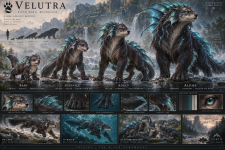

𝔹𝕒𝕤𝕚𝕔 𝕀𝕟𝕗𝕠𝕣𝕞𝕒𝕥𝕚𝕠𝕟
────────────────── ✦ ──────────────────
ℕ𝕒𝕞𝕖(𝕤): River Pup | Sailback Otter | River Hound
𝔾𝕖𝕟𝕕𝕖𝕣(𝕤): Male & Female
ℍ𝕖𝕚𝕘𝕙𝕥: 5 feet at the shoulder | 10 feet when standing upright
Alpha: 9 feet at the shoulder | 18 feet when standing upright
𝕎𝕖𝕚𝕘𝕙𝕥: 1,700 – 2,800 lbs
Alpha: 4,000 – 6,000+ lbs
ℙ𝕝𝕒𝕔𝕖 𝕆𝕗 𝕆𝕣𝕚𝕘𝕚𝕟: The Kricorian River Basin
ℂ𝕦𝕣𝕣𝕖𝕟𝕥 𝕃𝕠𝕔𝕒𝕥𝕚𝕠𝕟(𝕤): Large tropical rivers | flooded forests | estuaries | river deltas
Small populations have also been documented migrating between river systems through the ocean.
ℂ𝕝𝕒𝕤𝕤𝕚𝕗𝕚𝕔𝕒𝕥𝕚𝕠𝕟: Kaiju
𝕃𝕚𝕗𝕖 𝕊𝕥𝕒𝕥𝕦𝕤: Alive
𝕎𝕠𝕣𝕝𝕕 𝕊𝕥𝕒𝕥𝕦𝕤: Roaming
✦ ─────── K-101 ─────── ✦
𝕆𝕥𝕙𝕖𝕣 𝕀𝕟𝕗𝕠𝕣𝕞𝕒𝕥𝕚𝕠𝕟
────────────────── ✦ ──────────────────
ℂ𝕠𝕣𝕖 𝕊𝕥𝕒𝕥𝕦𝕤: Intact | 1 Alpha Devoured
ℂ𝕠𝕣𝕖 𝕋𝕪𝕡𝕖:
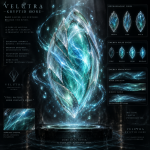
ℙ𝕖𝕣𝕤𝕠𝕟𝕒𝕝𝕚𝕥𝕪 𝕋𝕪𝕡𝕖: Despite their terrifying place within the food chain, Velutras are remarkably playful, social, curious, affectionate, and expressive creatures. Among members of their own species they behave much closer to enormous otters than monsters. They wrestle, chase each other through rivers, slide down muddy banks, carry interesting objects around, sleep in piles, and produce soft chirps, whistles, growls, and high-pitched barks. Velutras are particularly fascinated by unfamiliar objects and may approach boats, equipment, or people simply to investigate them. This behavior creates one of their greatest dangers to humans: they frequently do not understand how fragile other creatures are. A playful shove from an adult Velutra can break bones, while an excited animal jumping onto a person could easily kill them accidentally. Once hunting begins, however, the playful demeanor disappears almost completely. Velutras become extremely focused pursuit predators that rarely abandon prey once a chase has begun. Luckily, humans aren't part of their food source unless provoked, but they also remember those who hunted them rather than going on to hate all humans.
ℂ𝕒𝕥𝕖𝕘𝕠𝕣𝕪: I (Babies) | II (Large Adults) | III (Alpha)
ℕ𝕠𝕜𝕥𝕚𝕤 𝔸𝕤𝕤𝕖𝕤𝕤𝕞𝕖𝕟𝕥: Velutra classification frequently causes confusion among inexperienced operatives and should never be interpreted as an indication of physical weakness. Even a standard adult possesses enough strength to stop charging megafauna and enough speed to overwhelm most conventional pursuit methods, yet deliberate attacks against humans remain uncommon and are usually linked to territorial intrusion, injury to offspring, attempted capture, or aggression from specific individuals the Velutra remembers. Lethal engagement is strongly discouraged unless civilian lives are in immediate danger, as the species responds far better to distance, calm behavior, food diversion, and nonthreatening withdrawal than force. Operatives should not run from a curious specimen, as rapid retreat may trigger pursuit instincts, and personnel previously involved in harming or capturing a Velutra should not reapproach the same colony due to the species' exceptional recognition and memory. Alpha encounters are raised to Category III because of their increased physical capability, social authority, and Alpha Dread effect, but even an Alpha should not automatically be considered hostile. The preferred Noktis response remains observation, de-escalation, and avoidance of unnecessary conflict .

ℂ𝕠𝕞𝕓𝕒𝕥 𝕀𝕟𝕗𝕠𝕣𝕞𝕒𝕥𝕚𝕠𝕟
────────────────── ✦ ──────────────────
𝕊𝕥𝕣𝕖𝕟𝕘𝕥𝕙: Velutras possess disproportionately high physical strength for their classification. A healthy adult can stop large charging animals through a combination of raw power, leverage, and perfectly timed counter-momentum, and can throw multi-ton prey several meters if it gains proper footing. Their forelimbs and jaws are strong enough to overpower sharks, crocodilians, and large terrestrial animals, while their shoulders are built for explosive tackling and grappling. However, they are not consistently capable of destroying heavily reinforced structures or overpowering high-end Category IV Kryptids through strength alone. Their strength is terrifying in close combat, but still limited by their relatively conventional skeletal and muscular durability.
𝕊𝕡𝕖𝕖𝕕: Speed is the Velutra’s greatest combat advantage. On land they can accelerate almost instantly, covering short distances fast enough to overwhelm ordinary humans and many slower Kryptids before they can properly react. In water they are even more dangerous, where their sails, leg fins, head fins, and broad tail allow them to move with extraordinary control and acceleration. Their top speed is impressive, but their true advantage is how quickly they can start, stop, turn, and re-engage. They are not untouchable, however; experienced Hunters using predictive targeting, area-denial weaponry, traps, or wide-range Aegis attacks can still force them into unfavorable positions.
𝔻𝕦𝕣𝕒𝕓𝕚𝕝𝕚𝕥𝕪: Velutras are only moderately durable by Kryptid standards. Their bones, tendons, and muscles are reinforced enough to survive the forces created by their own movement, but their hide is not heavily armored and their internal organs are not exceptionally protected. High-caliber anti-Kryptid ammunition, reinforced Aegis blades, concentrated energy attacks, and powerful piercing strikes can injure them seriously. A Velutra survives primarily by avoiding hits rather than enduring them. Damage to the limbs, tail, dorsal sails, or spinal structure can drastically reduce its combat effectiveness.
𝕀𝕟𝕥𝕖𝕝𝕝𝕚𝕘𝕖𝕟𝕔𝕖: Velutras are highly intelligent animals rather than human-level tactical thinkers. They can recognize patterns, coordinate with other Velutras, remember specific enemies, identify traps after limited exposure, and quickly adjust hunting behavior. During combat they are capable of feints, flanking, ambushes, retreating into water, and using terrain to their advantage. They are especially dangerous in groups because they instinctively understand how to cut off escape routes and overwhelm isolated targets. Their curiosity, however, can still be exploited, and they can be baited or distracted more easily than truly sapient Kryptids.
ℝ𝕖𝕘𝕖𝕟𝕖𝕣𝕒𝕥𝕚𝕠𝕟: Velutras heal somewhat faster than normal animals but possess no meaningful combat regeneration. Cuts, fractures, puncture wounds, and internal injuries remain serious and can take days or weeks to heal. Lost limbs do not regrow, destroyed organs cannot simply be replaced, and severe trauma can kill them normally. Their recovery advantage is mainly increased clotting, efficient immune response, and accelerated tissue repair rather than supernatural regeneration.
𝔸𝕕𝕒𝕡𝕥𝕒𝕓𝕚𝕝𝕚𝕥𝕪: Velutras adapt extremely well to environmental changes and hunting conditions. They function effectively in rivers, lakes, flooded forests, coastal waters, mudflats, and dense terrestrial terrain. Their behavior changes depending on prey and surroundings, and they are capable of learning from failed encounters. However, they do not possess the rapid biological evolution associated with higher-level Kryptids. Their adaptations are behavioral and anatomical rather than instantaneous.
𝕎𝕖𝕒𝕜𝕟𝕖𝕤𝕤: The Velutra’s biggest weakness is its lack of defensive specialization. Despite its intimidating size and strength, a clean hit from proper anti-Kryptid weaponry can cause substantial damage. Its legs, fins, tail, and dorsal sails are particularly important to its mobility; injuring any of these structures significantly reduces both its speed and maneuverability. Wide-area attacks are especially effective because the Velutra relies heavily on dodging individual strikes. Sonic disruption can temporarily overload the sensitive organs around its head fins, causing disorientation and poor balance, although repeated exposure becomes less effective as the animal learns to anticipate it. Velutras also have very high caloric demands, meaning extended battles can gradually reduce their performance if they are unable to disengage and recover. Their curiosity can occasionally be exploited using unfamiliar moving objects, noises, or floating equipment, though experienced adults are much harder to distract once they recognize a threat.
✦ ─────── K-101 ─────── ✦
𝔸𝕓𝕚𝕝𝕚𝕥𝕪 𝕀𝕟𝕗𝕠𝕣𝕞𝕒𝕥𝕚𝕠𝕟
────────────────── ✦ ──────────────────
ℙ𝕣𝕚𝕞𝕒𝕣𝕪 𝔸𝕓𝕚𝕝𝕚𝕥𝕪: Torrent Drive
𝔸𝕓𝕚𝕝𝕚𝕥𝕪 𝔻𝕖𝕤𝕔𝕣𝕚𝕡𝕥𝕚𝕠𝕟: The biological acceleration system responsible for the Velutra's legendary speed. Rather than relying purely on muscle strength, the Kryptid's Core releases controlled bursts of kinetic energy throughout its nervous system and musculature. These impulses amplify every contraction of its body while dramatically reducing wasted motion. On land, a Velutra can explode into motion so quickly that observers frequently describe the creature as simply vanishing from its previous location. The species is capable of sprinting through forests, running along unstable riverbanks, leaping between cliffs, changing direction mid-stride, and weaving around obstacles without losing significant speed. Their large tails function as counterbalances, allowing turns that should be impossible for something weighing several thousand pounds. In water, the ability becomes even more extreme. Their dorsal sails stabilize the body while fins positioned behind the legs and along the sides of the head continuously adjust direction. Their tail produces tremendous thrust, turning the creature into a living underwater projectile. A Velutra can pursue sharks through open water, intercept fleeing prey from below, and burst through the surface without noticeably slowing down. Their movement between land and water is almost seamless. A specimen can sprint directly into a river and immediately transition into high-speed swimming without needing to reposition its body.
ℙ𝕒𝕤𝕤𝕚𝕧𝕖 𝔸𝕓𝕚𝕝𝕚𝕥𝕪 #𝟙: Exclusive to mature Alpha Velutras. An Alpha produces a constant low-frequency bio-energetic signal through its Core, dorsal sails, and vocal organs. Living creatures entering its territory experience an instinctive sensation that something overwhelmingly dangerous is nearby. Initial symptoms include increased heartbeat, sweating, shaking, difficulty breathing, and the overwhelming desire to flee. Extended exposure may produce:
• Loss of coordination
• Tunnel vision
• Freezing responses
• Panic attacks
• Temporary inability to attack
• Uncontrolled submission behavior in animals
The effect does not technically manipulate thoughts. Instead, Alpha Dread artificially activates ancient neurological survival responses and forces the victim's body to interpret the Alpha as an unavoidable apex predator. Even experienced Noktis operatives have described the sensation as their body attempting to run before their mind understands why. The Alpha itself is approximately twice the physical size of a normal adult and possesses roughly twice its strength, acceleration, sensory range, and kinetic output.
ℙ𝕣𝕚𝕞𝕒𝕣𝕪 𝔸𝕓𝕚𝕝𝕚𝕥𝕪 #𝟚: The species possesses extraordinary aquatic sensory abilities. The small fins positioned beside their heads act as both stabilizers and sensory organs capable of detecting subtle pressure fluctuations within surrounding water. A swimming creature creates minute disturbances that a Velutra can identify from kilometers away under favorable conditions. This allows them to hunt even in completely muddy water where visibility is effectively nonexistent. Once a target is detected, the Velutra can estimate its:
• Size
• Direction
• Swimming speed
• Approximate distance
• Injury state
• Whether multiple creatures are traveling together

✦ ─────── K-101 ─────── ✦
ℍ𝕚𝕤𝕥𝕠𝕣𝕪
────────────────── ✦ ──────────────────
The Velutra did not begin as a naturally occurring species. Noktis believes its origin traces back several centuries to a period when one of The Reaper’s contamination events reached a vast river system populated by giant otters, wolves, large crocodilians, river dolphins, sharks, and several early Kryptid species. Unlike a full Genesis Singularity outbreak, this event appears to have been limited and scattered, likely caused by a small quantity of Genesis Blood entering the water and spreading downstream. Most animals exposed to the contamination mutated violently and died, while others transformed into unstable Kaiju that vanished within a few generations. One lineage, however, adapted unusually well. Researchers theorize that a large semi-aquatic mammal; possibly an otter-like predator already adapted to fast currents, survived the initial mutation and passed its altered biology to its offspring. Through Progenitor’s Blessing, the creature did not simply inherit traits from The Reaper; its own genetics determined what the mutation became. The result was the earliest known Velutra: a powerful semi-aquatic Kryptid whose body specialized almost entirely around speed, strength, hydrodynamic movement, and social hunting rather than armor or regeneration.
Over successive generations, the Velutra changed rapidly. Their limbs became longer and stronger, their tails broadened into powerful aquatic rudders, and flexible sails began developing along the spine to stabilize their bodies at extreme speed. Smaller fins formed behind the legs and beneath the ears, allowing rapid changes in direction underwater without sacrificing momentum. Their Core system also evolved in a strange direction compared to most Kryptids. Rather than producing destructive energy or supernatural defenses, the Velutra Core became almost entirely dedicated to kinetic output, muscle efficiency, acceleration, reflexes, and movement. This specialization explains why even young Velutras can overpower animals far larger than themselves. Pups eventually became strong enough to fight predators such as tigers, while juveniles routinely hunted animals comparable to rhinoceroses, oxen, and large crocodilians. Adults reached the point where they could stop charging megafauna head-on and throw them aside with startling ease. Yet because almost nothing in their habitat could consistently kill them, the species never developed exceptional durability. Evolution simply had no reason to invest heavily in armor when speed, overwhelming strength, and coordinated hunting already solved nearly every threat they faced.
As Velutras spread throughout connected rivers and coastal zones, they became one of the dominant predators of their environment without behaving like typical territorial monsters. Their preferred prey shifted toward increasingly large targets, particularly sharks, large fish, aquatic Kryptids, and small whales that entered river mouths or coastal waters. Despite their position near the top of the food chain, they developed an unusually playful and social culture. Family groups wrestled in shallow water, chased each other through currents, slid down muddy riverbanks, collected strange objects, and slept in tightly packed groups. Their intelligence also increased alongside their social complexity. Velutras learned individual faces, scents, boats, hunting methods, and even recurring human behavior. Communities living near established populations gradually realized that the creatures rarely considered people food. Some local cultures even regarded them as river guardians because dangerous animals often disappeared shortly after a Velutra family moved into an area. Their greatest danger to humans came not from predation, but from scale. A creature capable of tossing a rhinoceros could injure a person simply by playing too roughly, and early encounters produced multiple accidental deaths before both humans and Velutras began learning how to interact around one another.
Noktis did not officially identify the Velutra until an investigation into the sudden disappearance of several large predators along a contaminated river corridor. Operatives expected to find a highly aggressive Category IV Kryptid but instead discovered a group of young Velutras playing with a surveillance device in shallow water. The animals chirped, chased it, and repeatedly carried it back toward the bank whenever it drifted away. The encounter appeared almost harmless until a nearby predatory Kryptid emerged from the forest. One juvenile immediately abandoned play, crossed the river in seconds, struck the creature hard enough to send it through several trees, and dragged it into the water before returning to its group. Further observation revealed the species’ defining contradiction: they were physically devastating but behaviorally manageable. Noktis later discovered that Velutras remembered specific individuals who harmed them and could hold grudges for years without becoming hostile toward humanity as a whole. A Velutra might ignore an entire research team while becoming instantly defensive around one operative who had previously injured it. This selective memory, combined with their curiosity and capacity for peaceful interaction, was a major reason Noktis ultimately classified most specimens as Category II, with dangerous adults, family groups, and Alphas reaching Category III rather than being ranked solely by raw physical power.
The discovery of the first confirmed Alpha revealed the final major stage of Velutra evolution. Alphas are approximately twice the size and capability of normal adults, with enlarged dorsal sails, greater muscular output, and an unusual field effect later designated Alpha Dread. Noktis believes this ability may be a distant evolutionary echo of The Reaper’s influence: instead of rewriting biology like Genesis Singularity, the Alpha’s Core emits a low-frequency bio-energetic pressure that forces nearby nervous systems into an instinctive fear response. Animals freeze, flee, or submit before the Alpha has even acted, while humans experience rapid heartbeat, shaking, tunnel vision, and an overwhelming urge to escape. Surprisingly, Alphas are usually among the calmest members of the species. They regulate family groups, protect pups, interrupt dangerous behavior, and rarely attack unless the colony is genuinely threatened. Modern Noktis researchers now view the Velutra as one of the strangest outcomes of The Reaper’s legacy. They are undeniably Kryptids, born from the same mutagenic origin that produced countless monsters, yet they developed into affectionate, intelligent, highly social apex predators rather than indiscriminate killers. To Noktis, the species serves as proof that The Reaper’s creations are not predetermined by cruelty. The Reaper may have provided the mutation, but the Velutra’s own biology, environment, and generations of adaptation determined what they ultimately became.
✦ ─────── K-101 ─────── ✦
𝔸𝕓𝕚𝕝𝕚𝕥𝕪 𝕀𝕟𝕗𝕠𝕣𝕞𝕒𝕥𝕚𝕠𝕟
────────────────── ✦ ──────────────────
ℙ𝕣𝕚𝕞𝕒𝕣𝕪 𝔸𝕓𝕚𝕝𝕚𝕥𝕪: Torrent Drive
𝔸𝕓𝕚𝕝𝕚𝕥𝕪 𝔻𝕖𝕤𝕔𝕣𝕚𝕡𝕥𝕚𝕠𝕟: The biological acceleration system responsible for the Velutra's legendary speed. Rather than relying purely on muscle strength, the Kryptid's Core releases controlled bursts of kinetic energy throughout its nervous system and musculature. These impulses amplify every contraction of its body while dramatically reducing wasted motion. On land, a Velutra can explode into motion so quickly that observers frequently describe the creature as simply vanishing from its previous location. The species is capable of sprinting through forests, running along unstable riverbanks, leaping between cliffs, changing direction mid-stride, and weaving around obstacles without losing significant speed. Their large tails function as counterbalances, allowing turns that should be impossible for something weighing several thousand pounds. In water, the ability becomes even more extreme. Their dorsal sails stabilize the body while fins positioned behind the legs and along the sides of the head continuously adjust direction. Their tail produces tremendous thrust, turning the creature into a living underwater projectile. A Velutra can pursue sharks through open water, intercept fleeing prey from below, and burst through the surface without noticeably slowing down. Their movement between land and water is almost seamless. A specimen can sprint directly into a river and immediately transition into high-speed swimming without needing to reposition its body.
ℙ𝕒𝕤𝕤𝕚𝕧𝕖 𝔸𝕓𝕚𝕝𝕚𝕥𝕪 #𝟙: Exclusive to mature Alpha Velutras. An Alpha produces a constant low-frequency bio-energetic signal through its Core, dorsal sails, and vocal organs. Living creatures entering its territory experience an instinctive sensation that something overwhelmingly dangerous is nearby. Initial symptoms include increased heartbeat, sweating, shaking, difficulty breathing, and the overwhelming desire to flee. Extended exposure may produce:
• Loss of coordination
• Tunnel vision
• Freezing responses
• Panic attacks
• Temporary inability to attack
• Uncontrolled submission behavior in animals
The effect does not technically manipulate thoughts. Instead, Alpha Dread artificially activates ancient neurological survival responses and forces the victim's body to interpret the Alpha as an unavoidable apex predator. Even experienced Noktis operatives have described the sensation as their body attempting to run before their mind understands why. The Alpha itself is approximately twice the physical size of a normal adult and possesses roughly twice its strength, acceleration, sensory range, and kinetic output.
ℙ𝕣𝕚𝕞𝕒𝕣𝕪 𝔸𝕓𝕚𝕝𝕚𝕥𝕪 #𝟚: The species possesses extraordinary aquatic sensory abilities. The small fins positioned beside their heads act as both stabilizers and sensory organs capable of detecting subtle pressure fluctuations within surrounding water. A swimming creature creates minute disturbances that a Velutra can identify from kilometers away under favorable conditions. This allows them to hunt even in completely muddy water where visibility is effectively nonexistent. Once a target is detected, the Velutra can estimate its:
• Size
• Direction
• Swimming speed
• Approximate distance
• Injury state
• Whether multiple creatures are traveling together
✦ ─────── K-101 ─────── ✦
ℍ𝕚𝕤𝕥𝕠𝕣𝕪
────────────────── ✦ ──────────────────
The Velutra did not begin as a naturally occurring species. Noktis believes its origin traces back several centuries to a period when one of The Reaper’s contamination events reached a vast river system populated by giant otters, wolves, large crocodilians, river dolphins, sharks, and several early Kryptid species. Unlike a full Genesis Singularity outbreak, this event appears to have been limited and scattered, likely caused by a small quantity of Genesis Blood entering the water and spreading downstream. Most animals exposed to the contamination mutated violently and died, while others transformed into unstable Kaiju that vanished within a few generations. One lineage, however, adapted unusually well. Researchers theorize that a large semi-aquatic mammal; possibly an otter-like predator already adapted to fast currents, survived the initial mutation and passed its altered biology to its offspring. Through Progenitor’s Blessing, the creature did not simply inherit traits from The Reaper; its own genetics determined what the mutation became. The result was the earliest known Velutra: a powerful semi-aquatic Kryptid whose body specialized almost entirely around speed, strength, hydrodynamic movement, and social hunting rather than armor or regeneration.
Over successive generations, the Velutra changed rapidly. Their limbs became longer and stronger, their tails broadened into powerful aquatic rudders, and flexible sails began developing along the spine to stabilize their bodies at extreme speed. Smaller fins formed behind the legs and beneath the ears, allowing rapid changes in direction underwater without sacrificing momentum. Their Core system also evolved in a strange direction compared to most Kryptids. Rather than producing destructive energy or supernatural defenses, the Velutra Core became almost entirely dedicated to kinetic output, muscle efficiency, acceleration, reflexes, and movement. This specialization explains why even young Velutras can overpower animals far larger than themselves. Pups eventually became strong enough to fight predators such as tigers, while juveniles routinely hunted animals comparable to rhinoceroses, oxen, and large crocodilians. Adults reached the point where they could stop charging megafauna head-on and throw them aside with startling ease. Yet because almost nothing in their habitat could consistently kill them, the species never developed exceptional durability. Evolution simply had no reason to invest heavily in armor when speed, overwhelming strength, and coordinated hunting already solved nearly every threat they faced.
As Velutras spread throughout connected rivers and coastal zones, they became one of the dominant predators of their environment without behaving like typical territorial monsters. Their preferred prey shifted toward increasingly large targets, particularly sharks, large fish, aquatic Kryptids, and small whales that entered river mouths or coastal waters. Despite their position near the top of the food chain, they developed an unusually playful and social culture. Family groups wrestled in shallow water, chased each other through currents, slid down muddy riverbanks, collected strange objects, and slept in tightly packed groups. Their intelligence also increased alongside their social complexity. Velutras learned individual faces, scents, boats, hunting methods, and even recurring human behavior. Communities living near established populations gradually realized that the creatures rarely considered people food. Some local cultures even regarded them as river guardians because dangerous animals often disappeared shortly after a Velutra family moved into an area. Their greatest danger to humans came not from predation, but from scale. A creature capable of tossing a rhinoceros could injure a person simply by playing too roughly, and early encounters produced multiple accidental deaths before both humans and Velutras began learning how to interact around one another.
Noktis did not officially identify the Velutra until an investigation into the sudden disappearance of several large predators along a contaminated river corridor. Operatives expected to find a highly aggressive Category IV Kryptid but instead discovered a group of young Velutras playing with a surveillance device in shallow water. The animals chirped, chased it, and repeatedly carried it back toward the bank whenever it drifted away. The encounter appeared almost harmless until a nearby predatory Kryptid emerged from the forest. One juvenile immediately abandoned play, crossed the river in seconds, struck the creature hard enough to send it through several trees, and dragged it into the water before returning to its group. Further observation revealed the species’ defining contradiction: they were physically devastating but behaviorally manageable. Noktis later discovered that Velutras remembered specific individuals who harmed them and could hold grudges for years without becoming hostile toward humanity as a whole. A Velutra might ignore an entire research team while becoming instantly defensive around one operative who had previously injured it. This selective memory, combined with their curiosity and capacity for peaceful interaction, was a major reason Noktis ultimately classified most specimens as Category II, with dangerous adults, family groups, and Alphas reaching Category III rather than being ranked solely by raw physical power.
The discovery of the first confirmed Alpha revealed the final major stage of Velutra evolution. Alphas are approximately twice the size and capability of normal adults, with enlarged dorsal sails, greater muscular output, and an unusual field effect later designated Alpha Dread. Noktis believes this ability may be a distant evolutionary echo of The Reaper’s influence: instead of rewriting biology like Genesis Singularity, the Alpha’s Core emits a low-frequency bio-energetic pressure that forces nearby nervous systems into an instinctive fear response. Animals freeze, flee, or submit before the Alpha has even acted, while humans experience rapid heartbeat, shaking, tunnel vision, and an overwhelming urge to escape. Surprisingly, Alphas are usually among the calmest members of the species. They regulate family groups, protect pups, interrupt dangerous behavior, and rarely attack unless the colony is genuinely threatened. Modern Noktis researchers now view the Velutra as one of the strangest outcomes of The Reaper’s legacy. They are undeniably Kryptids, born from the same mutagenic origin that produced countless monsters, yet they developed into affectionate, intelligent, highly social apex predators rather than indiscriminate killers. To Noktis, the species serves as proof that The Reaper’s creations are not predetermined by cruelty. The Reaper may have provided the mutation, but the Velutra’s own biology, environment, and generations of adaptation determined what they ultimately became.